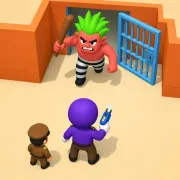
Loop Ghost
Loop Ghost seems brilliant at first, but as you learn what it does, it becomes hazardous in the best way. This puzzle game uses repetition, recollection, and the strange terror of discovering your prior self is in the machinery.
Features of the Loop Ghost game:
- Play every cycle to be recorded. Your ghost automatically repeats those movements on the next loop. Room becomes more than a room. This timeline has bad habits, good ideas, and enough pressure to rethink every move.
- The game tastes unique because of that idea. You solve levels repeatedly. You construct a solution over time. A button-holding version of you.
- Block-pushed by another. Another opens a route or rotates a mirror precisely. If you're stubborn enough to fail productively, numerous versions of the same character cooperate, making the challenge less about a single figure fleeing.
- Ghosts are not air. Tools. Sometimes very useful tools. Sometimes absolute proof of bad planning.
How to play the Loop Ghost game:
- Loop Ghost has a real hook. The game invites you to consider prior runs toward the answer. Many puzzle games treat failed attempts as failures.
- Here, your previous activities can form the correct solution. That twist is smart because it transforms how you view experiments. No cycle is wasted if it educates the space to work.
- The game is clever and curiously fun. You examine layers. First loop may be to reach a button. Fine. A block is moved by that door in the second loop. Third loop uses block to maintain button pushed while moving. Suddenly, the room changes. You lead many mute versions of yourself through a choreography puzzle.
- Unexpectedly satisfying idea. Watching a prior character do a work while your current self walks through the product is strangely cool. The place feels alive with memories. It also reduces failure judgment because a messy early loop can be useful later if you build around it.
Tips for playing Loop Ghost:
- A button opens a linked door. Easy. The game then asks who stays on the button as the other you walks through the door. Then simple mechanics become puzzles.
- This is a game highlight. Timing and duplication give familiar pieces weight. In a typical puzzle area, a button-pressed door is boring.
- Planning across cycles is needed here. The button-handling version of you? Now when? For how long? Can you trust the ghost to complete your task while you solve another? If the loop is properly built, yes. If you were lazy and thought your prior self was smarter, no.
- Structure makes even modest rooms satisfying. Hidden rules rarely cause problems. Order derives from arrangement. Synchronization. The level becomes a miniature machine with more moving parts each cycle.
- Pushing one onto a button keeps the pressure alive, allowing future cycles to be more intriguing. That should be soothing. Usually, it indicates the riddle has added another layer of responsibility. Now you must decide when and where to move the block and whether a ghost cycle or the present one is doing it.
- Because blocks last between cycles, the room feels cumulative. You don't always reset the world. You alter it. The conundrum creates history, which matters. Well-moved blocks simplify the next cycle brilliantly. A poorly shifted block can make the next cycle a moderately uncomfortable lesson in forethought.
Puzzle players enjoy this part. Making progress seems real. What you did before changes the room.
Arcade GamesAdventure Games